
Let’s define the terms “appetite” and “hunger”, two central concepts in appetite regulation.
Appetite may be considered the process that influences food intake; hunger reflects the motivation to eat food, together forming the behavioural expression of appetite and hunger.
As such, there are distinct processes that influence both appetite and hunger; these can be distinguished as homeostatic and hedonic processes involved in the homeostatic regulation of appetite.
Homeostatic processes reflect the control over how much food is eaten, quantitatively [i.e., energy intake], and are central to long-term appetite control.
Homeostatic regulation of energy intake is a balance between orexigenic [i.e., appetite promoting] and anorexigenic [i.e., appetite suppressing] pathways in the brain.
These processes influence both acute and long-term energy availability [both in diet and stored energy, i.e., body fat].
In theory, eating behaviour would be governed solely by our energy requirements, where we would only consume as much energy as required to meet energy expenditure demands.
However, humans evolved in natural environments with unpredictable food availability, and energy intake is not solely governed by homeostasis.
Food-related motivation-reward processes and environmental factors influence how much is eaten.
The motivation-reward influence on eating is known as the hedonic process, driven by two sides to our brain reward systems: “wanting”, driven by dopamine, and “liking”, driven by opioids and cannabinoids.
Wanting triggers the intense motivational urge for the food reward, while the opioid-driven liking response conveys the hedonic properties of food [often energy-dense, sugar, fat, and salt-rich foods].
The main point to take home is that the homeostatic regulation of appetite is not tightly controlled, and hedonic motivation to eat is influenced by social, environmental, and cognitive factors, which can promote consuming energy in excess of homeostatic needs.
Satiety vs. Satiation
Within the complex neurobiology of regulating food intake in humans, there are two overlapping processes that we must consider: satiation and satiety.
Satiation can be thought of as “within-meal”, i.e., the effects of food intake on internal inhibitory processes during consumption which bring the eating episode to an end.
Satiety can be thought of as “post-meal”, i.e., the effect after a meal on inhibitory mechanisms that influence subsequent appetite and return to hunger.
These inhibitory mechanisms of intra-meal and post-ingestive processes include:
Gastrointestinal and physical effects [e.g., food volume and rate of gastric emptying].
Appetite-stimulating and appetite-suppressing pathways in the brain.
Motivation-reward brain regions [“wanting” and “liking”, above].
Psychosocial factors like mood and emotional state, social situations, and time of day.
Overconsumption of food arises when there is an imbalance between the biological drive to eat and these inhibitory processes.
What if people may have weaker satiety responses compared to others?
Satiety Phenotypes
In 2015, John Blundell’s research group at the University of Leeds identified a “low-satiety phenotype”, describing individuals with a behavioural susceptibility to overeating that reflected impaired satiety mechanisms and altered appetite regulation.
Their research has subsequently compared the relationship between “high satiety” and “low satiety” phenotypes and weight loss.
They identify the respective satiety phenotypes based on their subjective fullness scores in response to a test meal.
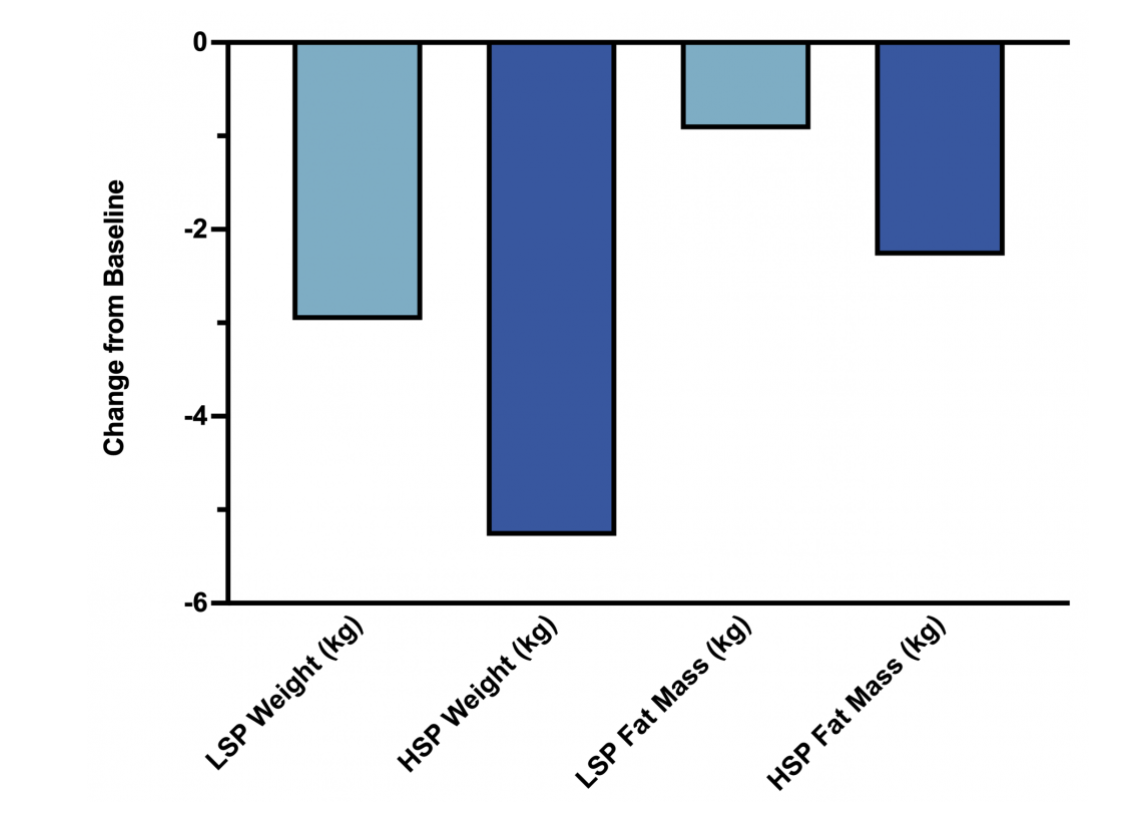
In one of the studies from this group, Buckland et al. (Br J Nutr. 2019;122(8):951-959), the differences in weight loss according to satiety phenotypes were quite striking (see figure, below).
Low-satiety phenotypes lost 2.97kg over 12 weeks, while the high-satiety phenotypes lost 5.28kg. Fat mass loss was also greater in the high-satiety phenotype participants.
Perhaps unsurprisingly, appetite control was more impaired in the low-satiety participants who found it harder to adhere to their diet, and reported significantly less control over their eating.
What was really interesting was that it appeared that the energy density of foods interacts with the satiety phenotype to influence energy intake.
In the test days, there was no difference between satiety phenotypes once low-energy-density foods were consumed.
Thus, it is possible that even in the context of low satiety, LED foods may exert some benefit for appetite control.
In another study from this group in men with obesity (Arguin et al. Br J Nutr. 2017 Nov 14;118(9):750–60), men on a low-energy-density diet showed greater weight loss compared to the control diet irrespective of satiety phenotype.
Importantly, appetite control was significantly improved on the low-energy-density diet in both low-satiety and high-satiety phenotype participants.
But Does Enhancing Appetite Lead to Weight Loss?
However, while it may be tempting to draw a straight line between enhanced appetite regulation, leading to lower energy intake, leading to weight loss, here is where we must pause filling in evidential gaps.
In a paper by Sumithran et al. (NEJM. 2011;365(17):1597–604), elevated levels of appetite regulatory hormones and subjective appetite ratings were not correlated with weight regain over 1 year of follow-up.
In addition, subjective appetite measures, while useful to represent changes in subjective levels of appetite and hunger, do not correlate strongly with actual energy intake.
If increased appetite or hunger may not necessarily predict weight regain based on current evidence, does enhancing appetite and hunger regulation make a difference for weight loss success and maintenance?
The evidence for this specific research question is surprisingly sparse.
In the SATIN trial (Hansen et al. J Nutr Sci. 2019;8:e39), there were moderate correlations between appetite suppression scores and weight loss maintenance.
Another recent study (Nymo et al. Int J Obes. 2018;42(8):1489–99) showed that both fasting and postprandial levels of hunger and fullness were higher immediately after weight loss.
However, after 1 year of maintenance, while fasting hunger remained higher than baseline, postprandial fullness ratings were also higher.
Thus, it may be that increased postprandial fullness levels offset higher subjective fasting hunger after a period of weight loss maintenance.
And in the recent Big Breakfast Study (Ruddick-Collins et al. Cell Metab. 2022;34(10):1472-1485.e6), appetite was enhanced with high morning energy intake compared to evening energy intake.
However, these diets were fully controlled and isocaloric, so any effect of appetite on enhancing weight loss could not be demonstrated.
What Conclusions Can We Draw?
Cumulatively, the needle tips towards a relationship between appetite measures and weight loss.
However, the glaring gap in this field is the lack of interventions testing this relationship as an a priori hypothesis.
To date, weight loss interventions measure appetite markers as secondary outcomes.
As such, there is a lack of trials which have directly tested nutritional strategies to enhance appetite as the primary “exposure” of interest.
The current evidence does not quite permit us to conclude that enhanced appetite is a causal mediator of energy reductions and weight loss in the context of appetite regulation.
Yours in Science,
Alan
Learn with Us.
You’ll find our most comprehensive resources in the Alinea Nutrition Education Hub.
Our weekly Deepdive takes a take a forensic look at a recent study: you’ll understand the background, the findings, and the relevance of the study in the context of the wider literature.
Our bi-monthly video Research Lectures condense complex topics into a visual presentation for you to maximise your learning experience.
And Exclusive Articles from researchers and academics in the field of nutrition science provide insights and perspectives from the people producing the research.