

The stream of nonsense related to the health effects of polyunsaturated fats [PUFA] is neverending.
One of the most common claims about the supposed negative health effects of PUFA relates to a buzzword much beloved by the Quacks: “oxidation”, spreading widespread misinformation about pufa oxidation.
This is a classic case of using a fancy/technical/science-y sounding term without any regard for its real meaning.
In fact, the oxidation of PUFA may explain one of the main metabolic benefits of these fatty acids.
What Does Oxidation Mean?
The term “oxidation” may have two meanings.
The first relates to a biological process known as “redox balance”, which relates to the competing production of free radicals from the normal processes of metabolism, and the “anti-oxidant” processes that neutralise free radicals.
This is what Quacks are referring to in relation to PUFA, and is a claim for which there is no human evidence to support, especially concerning harmful pufa oxidation.
Studies directly testing the pro-oxidative effects of PUFA using isoprostanes, which have strong utility as biomarkers of oxidative stress, have not demonstrated this effect in humans.
If you haven’t already, read my article on PUFA for more on these studies.
The second meaning of the term relates to the metabolic fate of fatty acids, of which there are two: “beta-oxidation” and “esterification”.
Beta-oxidation, or “oxidation” for short, is the process by which fatty acids are utilised for energy production.
“Esterification” is the storage pathway, the process through which fatty acids are packaged into triglycerides and stored.
Metabolic Effects of PUFA
Several lines of evidence have offered suggestive insights into the metabolic effects of PUFA.
For example, PUFA-rich meals may form larger chylomicrons [intestinally-derived lipoproteins that transport fats consumed from the diet into circulation], which are cleared more rapidly in the postprandial period.
A study using stable isotope tracers from Professor Leanne Hodson’s group at the Oxford Centre for Diabetes, Endocrinology, and Metabolism showed that omega-3 PUFA led to a 20% decrease in triglycerides in chylomicrons.
And there are several studies demonstrating that omega-6 PUFA protect against liver fat accumulation compared to saturated fatty acids.
What Could Explain These Effects?
While the outcomes described above have been clear, one question that has not been clear is how and why PUFA may exert these effects.
One line of evidence suggested that PUFA may be preferentially shuttled into energy production, i.e., oxidation, over esterification, highlighting the positive metabolic role of pufa oxidation.
However, direct evidence of such an effect in humans has been limited to date.
In 2021, Prof. Hodson’s research group conducted an experimental intervention consisting of two single-meal postprandial test days.
The test meal contained 44g carbohydrate, 42g fat, and 10g protein, with a relatively equal balance between PUFA, saturated fatty acids [SFA], and monounsaturated [MUFA] fatty acids in the meal.
This meal was then enriched with the addition of either of two fatty acid tracers, either linoleate [a form of omega-6 PUFA] or palmitate [a form of SFA].
For each test day, samples were provided by participants immediately preceding the meal, and then at 30-minute intervals for a total of 360mins [6 h] postprandial.
The primary outcome measure was the oxidation of the PUFA-tracer compared to the SFA-tracer in the postprandial period.
What Did the Study Show?
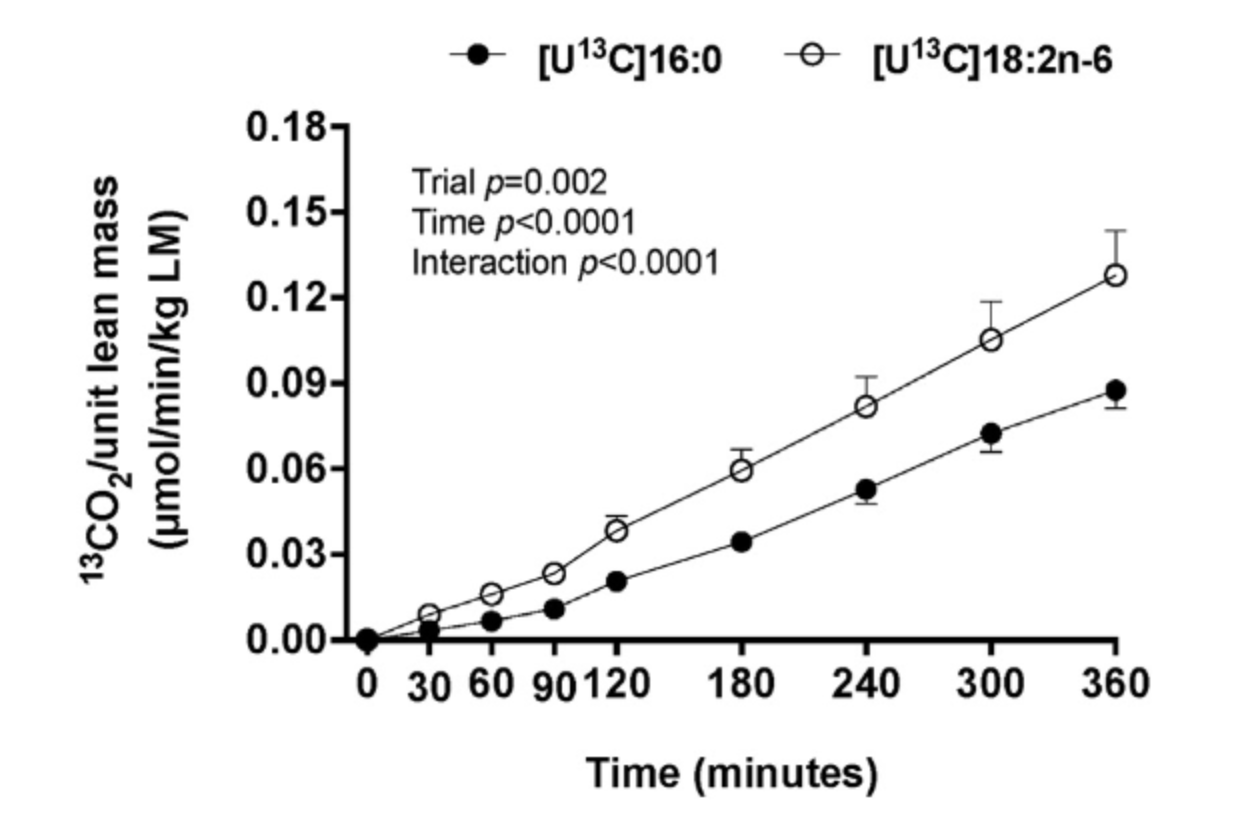
The appearance of the PUFA-tracer was significantly greater compared to the SFA-tracer, indicating greater oxidation of the PUFA-tracer that was evident across the entire 360min postprandial period.
You can see this clearly in the figure, below, from the paper; because the PUFA [in open circles] is being measured through the recovery of the added tracer in the sample.
The figure clearly shows that from 30 minutes postprandial onwards, the appearance of the PUFA-tracer is significantly greater.
Thus, PUFA was oxidised with greater efficiency compared to the SFA-tracer, providing clear evidence of beneficial pufa oxidation.
The study also measured the rate at which the respective fatty acid tracers were incorporated into plasma triglycerides and lipoproteins.
The incorporation of the SFA-tracer into plasma triglycerides was ~36% greater compared to the PUFA-tracer.
The SFA-tracer also appeared in circulating free fatty acids at a ~53% greater rate compared to the PUFA-tracer.
What Does This All Mean?
There is a fairly comprehensive body of evidence showing that the replacement of SFA with PUFA improves cardio-metabolic risk factors and disease outcomes, and risk of visceral and liver fat is part of this evidence.
The Hodson group study added to the experimental evidence explaining these metabolic differences, which points to the favourable metabolic effects of PUFA in the postprandial period.
Specifically, it appears that PUFA are preferentially shuttled toward oxidation [energy], and away from esterification [storage], while SFA shows the opposite tendency.
The analysis of the incorporation of the fatty acid tracers into different lipid compartments provided valuable additional insight.
The fact that more SFA-tracer appeared as free fatty acids and triglycerides may provide some explanation for the greater increase in liver fat observed with SFA compared to PUFA.
Thus, it appears that when it comes to PUFA, more oxidation is better, confirming the metabolic advantages of pufa oxidation!
Yours in Science,
Alan
Learn with Us.
You’ll find our most comprehensive resources in the Alinea Nutrition Education Hub.
Our weekly Deepdive takes a take a forensic look at a recent study: you’ll understand the background, the findings, and the relevance of the study in the context of the wider literature.
Our bi-monthly video Research Lectures condense complex topics into a visual presentation for you to maximise your learning experience.
And Exclusive Articles from researchers and academics in the field of nutrition science provide insights and perspectives from the people producing the research.