
Much of the nutritional focus for the presence, and removal, of fat in the liver emphasises total energy intake and macronutrient composition.
Indeed, the primary driver of increasing fat storage in the liver is excess energy, independent of the macronutrient source.
That said, macronutrient composition, specifically the composition of dietary fats [e.g., saturated vs. unsaturated] does influence fat accumulation in the liver, independent of energy excess.
But what of micronutrients?
There is an interesting body of evidence for supplemental vitamin E in liver disease.
Let’s discuss some of this evidence.
But First, Liver Recap…
The figure, below, illustrates the spectrum of fatty liver disease, from the initial progression to steatosis.
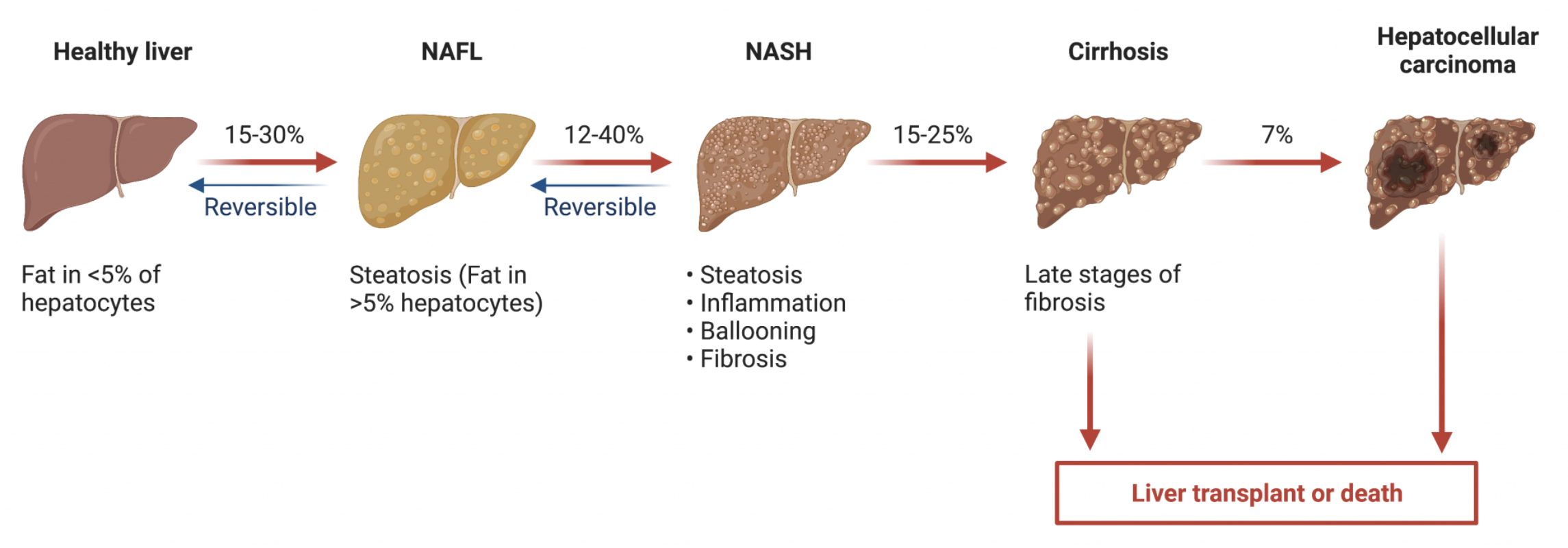
Non-alcoholic fatty liver [NAFL] is diagnosed as the presence of intracellular fat in >5% of liver cells [hepatocytes]. From NAFL, the next stage is non-alcoholic steatohepatitis [NASH], the most severe form of fatty liver.
The difference between NAFL and NASH is that in addition to steatosis [e.g., excess fat in the liver], NASH is characterised by “ballooning” [an abnormal enlargement of liver cells, hepatic inflammation] and fibrosis [scarring of liver tissue].
The spectrum of fatty liver disease may lead ultimately to liver cirrhosis and cancer.
The percentages between each stage represent broad estimates of the incidence ranges in the general population.
NAFL and NASH tend to be the main focus of nutrition research, because these stages may be reversible through dietary intervention, a key factor driving studies on vitamin E and NAFLD.
Why Could Vitamin E Be Good for Liver Health?
Let’s recap a bit on vitamin E.
The first thing to note is that Vitamin E is comprised of four tocopherols [alpha (α), beta (β), gamma (γ) and delta (δ)], and four tocotrienols [alpha (α), beta (β), gamma (γ) and delta (δ)].
The second important thing to note about vitamin E: it is a fat-soluble vitamin, and the major fat-soluble antioxidant in the body.
α-tocopherol has historically assumed pride-of-place in the vitamin E world, due to it being the predominant form in circulation, primarily carried by VLDL and LDL.
In this capacity, vitamin E acts to protect circulating lipoproteins against oxidation.
This is in line with the main mechanistic understanding of vitamin E functions, namely anti-oxidative and anti-inflammatory activities.
For the tocotrienols, we know much less about their specific biological activity relative to α-tocopherol.
However, their chemical difference from tocopherols means that tocotrienols are more efficiently absorbed into tissues with saturated fatty acid tissue layers, such as the liver.
Isoform for isoform, tocotrienols exhibit greater anti-oxidant and anti-inflammatory effects compared to tocopherols, however, their metabolism is more rapid and they have a much shorted half-life compared to α-tocopherol.
What About Liver Outcomes?
In the TONIC trial [Levine et al., JAMA. 2011 Apr 27;305(16):1659] in children with liver disease, 800IU/d natural form α-tocopherol resulted in the resolution of NASH in 58% of participants compared to 28% in the placebo group.
However, there was no effect on the liver enzyme ALT in children with NAFL, which was the primary endpoint of the trial.
In adults, the PIVENS trial [Sanyal et al. NEJM. 2010 May 6;362(18):1675–85] showed that 800IU/d natural form α-tocopherol resulted in significant reductions in liver fat, inflammation, and ballooning, in participants with NASH.
A systematic review and meta-analysis by Vadarlis et al. [JGH. 2021;36(2):311-319] included four trials in patients with NAFL and three in patients with NASH, providing crucial data on vitamin e and nafld.
Vitamin E supplementation resulted in a significant decrease of the liver enzymes ALT and AST by 7.37IU/L and 5.71IU/L, respectively.
However, when confining the analysis just to participants with NASH, the effect was stronger again: a 16.49IU/L and 12.78IU/L decrease for ALT/AST, respectively.
Vitamin E supplementation also lowered liver fat by 0.61%.
What Can We Take From this Evidence?
The overall body of evidence indicates benefits to vitamin E supplementation on markers of liver function in adults with NALF, reinforcing the therapeutic potential of vitamin e and nafld protocols.
Vitamin E appears to exert greater magnitudes of effect in adults with higher baseline ALT/AST values and/or with a diagnosis of NASH.
Thus, although the magnitude of effect is greatest in participants with NASH, vitamin E supplementation may provide a moderate benefit to a fatty liver before full-blown NASH.
However, recall that there are some interesting suggestive benefits to the tocotrienols specifically, beyond α-tocopherol alone.
This greater potential effect on oxidative stress and inflammation means that tocotrienols have emerged as potential therapeutic agents for liver disease.
Some intervention trials have used either mixed tocotrienols or delta(δ)-tocotrienol, and found benefits to supplementation with these vitamin E isoforms.
However, we currently lack a better understanding of both the optimal isoform(s) of tocotrienols and the effective dose thereof in adults with liver disease.
Ultimately, recommendations for vitamin E supplementation in adults with NASH are supported by the American Association for the Study of Liver Diseases.
For the clinicians among you working in this area, vitamin E supplementation is supported as an adjuvant option for the treatment of NAFLD, specifically NASH, which is a significant milestone in the ongoing research on vitamin e and nafld.
As a supplement form, the strength of evidence does appear to be natural form α-tocopherol.
In the meantime, the research on tocotrienols remains an interesting area to keep a tab open on
Yours in Science,
Alan
Learn with Us.
You’ll find our most comprehensive resources in the Alinea Nutrition Education Hub.
Our weekly Deepdive takes a take a forensic look at a recent study: you’ll understand the background, the findings, and the relevance of the study in the context of the wider literature.
Our bi-monthly video Research Lectures condense complex topics into a visual presentation for you to maximise your learning experience.
And Exclusive Articles from researchers and academics in the field of nutrition science provide insights and perspectives from the people producing the research.