
This historic focus of nutrition science was on single nutrients and the potential interaction of isolated nutrients.
For example, the replacement of saturated fat with unsaturated fats for lowering blood cholesterol and cardiovascular disease [CVD] risk is one of the most well-established facts in nutrition research regarding diet and heart disease.
However, in recent decades, the single nutrient focus has been expanded into a much more nuanced position in which the whole food matrix is considered as an exposure of interest.
In this paradigm, it is acknowledged that multiple components of a given food may act synergistically to influence health.
And viewing food as the relevant exposure inherently is more applicable in daily life, as people eat food, not isolated nutrients.
Going Nuts for Unsaturated Fats
Within the broad definition of unsaturated fat falls several specific food sources which have attracted particular research attention: oily fish, extra-virgin olive oil and other vegetable oils, seeds, and nuts.
Oily fish and extra-virgin olive oil do, however, receive a lion’s share of the attention. Nuts, however, had largely flown under the radar until the PREDIMED trial was published.
In one of the few interventions to directly compare food sources of unsaturated fats, in the context of diet and heart disease, PREDIMED compared two intervention groups enriched in unsaturated fats to a control diet.
Both groups consumed Mediterranean diets, but one intervention group consumed 4 tablespoons of extra-virgin olive oil per day, while the other group consumed 30g of mixed nuts [almonds, hazelnuts, walnuts] per day.
While both olive oil and nut diets resulted in similar 30% risk reduction for overall cardiovascular disease events, interestingly, the added mixed nuts diet displayed a greater reduction in risk for stroke and myocardial infarction.
The figure from the PREDIMED trial below illustrates the relative risk reduction for cardiovascular disease events from the olive oil diet [green line] and mixed nuts diet [orange line] compared to the control diet [black line].
![Illustration of the relative risk reduction for cardiovascular disease events from the olive oil diet, green line, and mixed nuts diet [orange line] compared to the control diet, black line,](https://alineanutrition.com/wp-content/uploads/2026/04/AN_diet-and-heart-disease-01.png)
So, by what mechanism might nuts reduce cardiovascular risk and influence the link between diet and heart disease?
Nuts and Cardiovascular Benefits
Nuts are a rich source of both monounsaturated and polyunsaturated fats [which differ depending on the type of nut], phytosterols, fibre, and also provide a source of protein.
Thus, it could be the particular nutrient constituents of this food group which underscore their health effects. A 2015 meta-analysis by Del Gobbo et al. reviewed intervention studies on nut consumption and CVD risk factors.
Data from the included studies were standardised to a 28g [1oz] daily serving of nuts. To investigate dose-responses, the absolute level of nut intake in grams per day was analysed against the absolute change in the outcomes.
61 trials [42 randomised and 18 non-randomised] met the inclusion criteria and were included in the study, encompassing a total of 2,582 participants with a mean age of 45yr. 41 trials included both men and women.
Participants in each trial were provided with nuts to consume daily, and the average dose was 56g/d, with a range from 5-100g.
21 trials investigated walnuts, and 16 investigated almonds, others included pistachios [n=7], hazelnuts [n=6], macadamia nuts [n=4], Brazil nuts [n=1], and 2 investigated mixed nuts.
Each 28g serving of nuts a day resulted in, on average, the following reductions in blood lipids:
- Total Cholesterol: –4.7mg/dL [95% CI –5.3 to –4.0mg/dL]
- LDL-C: –4.8mg/dL [95% CI –5.5 to –4.2mg/dL]
- ApoB: –3.7mg/dL [95% CI –5.2 to –2.3mg/dL]
- Triglycerides: –2.2mg/dL [95% CI –3.8 to –0.5mg/dL]
There were no significant differences observed for any of the other lipid outcomes, blood pressure, or inflammation, either from all trials combined or separately analysing randomised and non-randomised trials.
The dose-response analysis, as you can see in the figure below, indicated that a minimum dose of ~60g nuts per day yielded the greatest reductions in total cholesterol and LDL-C.
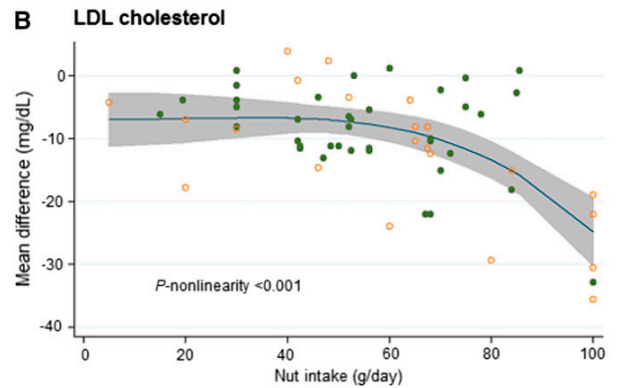
Interestingly, the primary factor in the reduction of LDL-C appeared to be the total dose of nuts, rather than any specific type of nuts that were used consumed in the primary included trials
Higher doses of nuts would imply higher doses of the constituents in nuts: could this explain some of the findings?
Looking Beyond the Fatty Acid Composition
Del Gobbo et al. published a separate analysis, which specifically examined the relationship between nut phytosterols and LDL-C.
Because the analysis was based on a standardised 28g/d of nuts, phytosterol levels were determined by multiplying the amount of nuts by the phytosterol content of the different nut types.
They then analysed the effects of phytosterol levels on LDL-C, with and without adjusting for the total content of nuts.
The total phytosterol dose was associated with a significant reduction in LDL-C, as you can see in the figure below, with a moderate strength of correlation of r = –0.60.
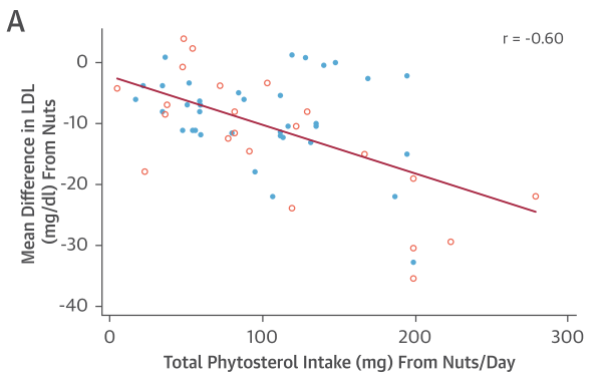
After adjusting for the total intake of nuts, the independent effect of phytosterols was no longer evident. However, total phytosterol content was highly correlated with total nut intake, r = 0.84
The implication is that differences in phytosterol content between different types of nuts are not likely relevant, and aiming for higher total daily doses of any type of nut may, through phytosterol content, lower LDL-C.
Thus, while the heart health benefits of nuts are often attributed to unsaturated fat and fibre content, it would appear that phytosterol content of higher nut intakes is a factor in reducing LDL-C levels.
Should Nuts Be a Cardiovascular Health Staple?
The consistent finding of reductions of risk for heart disease from high nut intake in epidemiology has some biological plausibility in the effects of nuts on cholesterol levels observed in intervention studies focusing on diet and heart disease.
Although the magnitude of effect may not be enormous, it may be clinically relevant in the context of a wider heart-health promoting dietary pattern.
The Del Gobo et al. meta-analysis indicated that the greatest reduction of LDL-C observed in randomised controlled trials was against the background American Heart Association diet, an average of 6.9mg/dL reduction.
It is plausible that the contribution of higher nut intake to daily phytosterol intake underpins this effect, given their inhibition of cholesterol uptake and reabsorption.
The most effective dose of phytosterols for cholesterol reduction is ~2g/d, and the maximum level in the Del Gobo et al. study was ~275mg – could greater nut phytosterol intake result in a greater reduction in LDL-C? Perhaps.
And, it is important to bear in mind that other constituents of nuts, unsaturated fats and fibre, may also exert beneficial effects.
Nonetheless, the evidence indicates that nuts are a beneficial food group for cardiovascular health, potentially mediated by the contribution to phytosterol intake and offering a simple approach to managing diet and heart disease.
Nuts are quite a defined nutritional exposure, and relatively small amounts in the 30-100g range are easily added to the diet, requiring no preparation.
The minimum effective dose appears to be 30g, but perhaps intakes of >60g/d would confer an additional benefit for lowering blood cholesterol levels.
Yours in Science,
Alan
Learn with Us.
You’ll find our most comprehensive resources in the Alinea Nutrition Education Hub.
Our weekly Deepdive takes a take a forensic look at a recent study: you’ll understand the background, the findings, and the relevance of the study in the context of the wider literature.
Our bi-monthly video Research Lectures condense complex topics into a visual presentation for you to maximise your learning experience.
And Exclusive Articles from researchers and academics in the field of nutrition science provide insights and perspectives from the people producing the research.