
According to the NOVA classification system, ultra-processed foods [UPF] are defined as:
“formulations of ingredients, mostly of exclusive industrial use, typically created by a series of industrial techniques and processes”.
UPF foods are currently estimated to comprise >50% of daily energy intake in several countries. The widespread consumption of ultra processed foods makes this a vital area of study.
However, a major issue with the NOVA classification is that it lacks sensitivity and specificity to describe the effects of different food types, their nutrient contents, and their sensory properties.
In particular, sensory factors such as food texture, and macronutrient composition, may be independently and relatedly important for determining the potential impacts of UPF on health.
From a macronutrient perspective, higher dietary protein intakes are associated with greater satiation than carbohydrates and fats, and are associated with free-living reductions in total energy intake.
Conversely, high UPF diets have been shown in controlled feeding studies to result in significant increases in total daily energy intake by ~500kcal/d compared to minimally-processed foods diets.
Could increasing the protein content of UPF be a strategy to mitigate against the potential overconsumption of energy from diets high in UPF? When evaluating ultra processed foods, this is a critical question.
High-Protein Ultra-Processed Feeding
In a paper published earlier this year contributing to ongoing ultra processed foods research, Hägele et al. reported on their results from a randomised, controlled feeding, crossover study in healthy adult male and female participants.
Participants were randomised to the order of the two diets, which were separated by a washout period of ~4 days:
- High-Protein Low-Carb [HPLC-UPF]: A diet of 30% protein, 29% carbohydrates, and 38% fat, comprised of 84% UPF.
- Normal-Protein Normal-Carb [HPLC-UPF]: A diet of 13% protein, 45% carbohydrates, and 38% fat, also comprised of 84% UPF.
Both diets were consumed over a 2-day period during a residential stay in the researchers’ laboratory.
A 3-day run-in period preceded each high-UPF diet phase, during which participants consumed the same macronutrient profile as the 2-day in-laboratory dietary intervention, but with 40% UPF.
All meals were provided to participants in excess to facilitate ad libitum eating during both study phases.
The primary outcome was energy balance, including energy intake and energy expenditure.
What Did the Study Find?
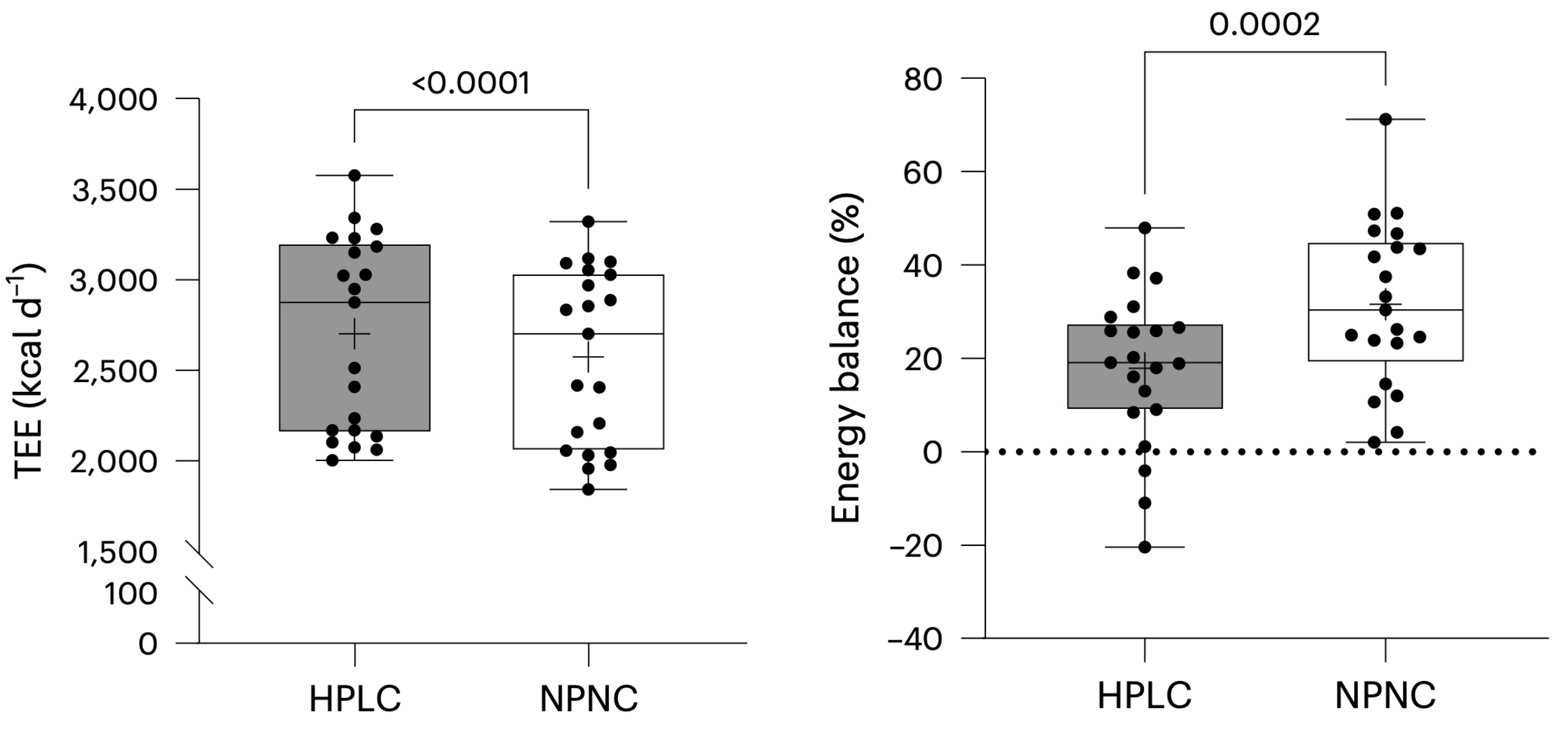
Both diets resulted in positive energy balance; however, the magnitude of energy surplus of +18% on the HPLC-UPF diet was significantly lower than the +32% increase on the NPNC-UPF diet.
Compared to the NPNC-UPF diet, the HPLC-UPF diet resulted in –196kcal/d [± 396] less ad libitum energy intake.
Compared to the NPNC-UPF diet, the HPLC-UPF diet also resulted in 128kcal/d [± 98] higher total daily energy expenditure.
The box plots from the paper below illustrate [left] total daily energy expenditure during the high-UPF diets and [right] overall energy balance during the high-UPF diets.
Eating rate [in grams per minute] and energy intake rate [in kcal per minute] were significantly lower on the HPLC-UPF diet compared to the NPNC-UPF diet.
Compared to the NPNC-UPF diet, the HPLC-UPF diet showed significantly lower postprandial ghrelin levels and higher PYY levels, indicating greater postprandial satiety on the HPLC-UPF diet. This physiological response is a key metric in modern ultra processed foods research.
However, while the changes in appetite hormones suggested higher satiety on the HPLC-UPF diet, subjective appetite was significantly higher on the HPLC-UPF diet compared to the NPNC-UPF diet.
How Should We Interpret the Findings?
The trial had a robust design, with full diet control and participants residing in a calorimetry chamber to measure energy expenditure throughout their residential period in the laboratory.
This meant that both sides of the energy balance equation—energy intake and energy expenditure—were precisely measured, allowing for accurate inferences into their respective contributions to energy balance.
Thus, the 14% greater energy surplus on the NPNC-UPF diet compared to the HPLC-UPF diet was explained by the combined 196kcal/d lower energy intake and the 128kcal/d increase in total daily energy expenditure.
Increased total daily energy expenditure from high-protein diets is a consistent finding in respiratory chamber research, reflecting the thermogenic effects of protein digestion.
Given the accuracy of the energy balance assessments, however, let’s think a little more critically about the differences between the two diets.
The first point to note here is that both diets still resulted in significant energy excess during the high-UPF phase.
And what the authors perhaps conveniently overlooked is the absolute increase in energy intake between the 40% UPF and high-UPF phase.
Energy intake on the HPLC diet increased by 760kcal/d compared to an increase of 589kcal/d on the NPNC diet.
So, higher protein intake may result in lower total energy intake compared to normal protein intake at either level of UPF, but a high UPF intake may result in substantial increases in energy intake despite high protein intake. This highlights the complex nature of diets heavy in ultra processed foods.
We should also bear in mind that the absolute difference in energy intake between diets was 196kcal/d, which is relatively modest.
More importantly, the standard deviation was ± 396kcal/d, indicating very high variability in the differences in energy intake between the HPLC and NPNC diets.
You can see the individual data points for energy intake in the box plot, below.
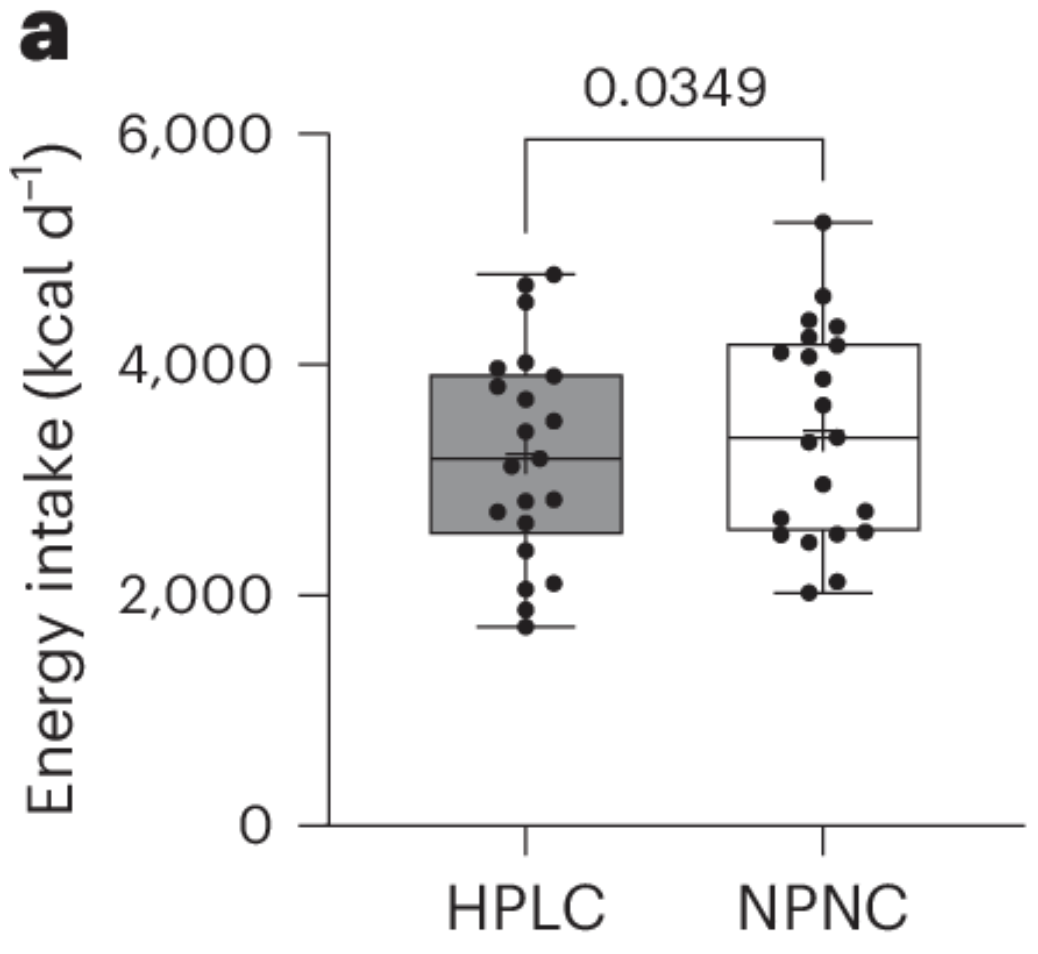
In a small study like this, the spread of the data points is not particularly convincing of any important difference between diet compositions in the context of very high UPF intakes.
The Pre-Lab Diets Provide Some Further Insights
Recall that the study involved a 3-day run-in diet with 40% UPF before the high-UPF respiratory chamber phase.
As macronutrients stayed constant for these 5 days, the shift from the 40% UPF run-in to the 84% UPF test diet provided insights into the potential independent effects of protein on energy intake in a high-UPF diet.
What is pretty striking is the difference in energy intake between the diets during these phases.
Recall that the energy intake between diets during the high-UPF phase was lower by –196kcal/d on the HPLC diet.
However, during the 40% UPF phase, energy intake was –367kcal/d lower on the HPLC diet compared to the NPNC diet.
So, the effect of the high-protein intake was more pronounced with lower UPF in the diet compared to higher UPF.
Thus, whatever advantage higher protein intake may confer in regulating energy intake relative to UPF appeared to be diminished with very high UPF intakes in the experimental diets.
This is consistent with the wider emerging evidence demonstrating that other characteristics of UPF, such as texture, influence a greater eating rate and energy intake rate with UPF foods.
Final Thoughts
It is important to note that within the classification of UPF, there is substantial heterogeneity in the specific nutrient and sensory characteristics of different UPF foods.
This likely relates to heterogeneity in the observed effects of UPF on eating behaviour, energy intake, and health.
The Hägele et al. study was somewhat artificial in administering diets of ~84% UPF. Despite this limitation, the study contributes meaningful data to the growing body of ultra processed foods research.
The most parsimonious application of the study is that at such high levels of UPF intake, macronutrient variations may yield modest differences in energy intake.
However, those modest differences are negated by the substantial energy surplus that was observed in both diets, irrespective of macronutrient composition.
As I send this, I’m at a two-day conference in Wageningen on ultra-processed foods delivered by researchers in this field.
Hopefully, next week, I’ll report back on the discussions and the evidence presented.
Yours in Science,
Alan
Learn with Us.
You’ll find our most comprehensive resources in the Alinea Nutrition Education Hub.
Our weekly Deepdive takes a take a forensic look at a recent study: you’ll understand the background, the findings, and the relevance of the study in the context of the wider literature.
Our bi-monthly video Research Lectures condense complex topics into a visual presentation for you to maximise your learning experience.
And Exclusive Articles from researchers and academics in the field of nutrition science provide insights and perspectives from the people producing the research.