
We definitely know that energy balance is the primary determinant of the accumulation of fat in the liver, which is why calorie control is a staple of a fatty liver diet.
However, recent evidence has highlighted that the composition of fatty acids in the diet may influence the magnitude of liver fat increases or decreases.
The Finnish research group under the tutelage of Dr Hannele Yki-Järvinen have conducted numerous elegant interventions in the area of diet and fatty liver, providing valuable insights into the optimal fatty liver diet.
In a 2018 paper published in the journal, Diabetes Care, her group overfed participants by 1,000kcal/d from saturated fats, unsaturated fats, or simple sugars, respectively.
They found that the different overfeeding diets resulted in a hierarchical effect of increasing liver fat: intra-hepatic triglycerides [IHTG] increased by:
- 55% on the saturated fat diet
- 33% in response to simple sugars
- 15% in response to unsaturated fats
However, the unsaturated fat group in the above-mentioned study was primarily monounsaturated fats, rendering it impossible to distinguish any distinct effects of unsaturated fat types.
Are Polyunsaturated Unique in their Hepatic Effects?
There has long been interest in the effects of polyunsaturated fat [PUFA] on post-prandial metabolism.
A 2002 paper showed that 5 weeks on a weight-maintenance PUFA-rich diet led to significant decreases in abdominal fat and increased insulin sensitivity, compared to an SFA-rich diet.
However, liver fat was not measured in that study.
In the HEPFAT trial, Bjermo et al. compared the effects of weight-maintenance diets containing 15% omega-6 PUFA vs. 20% SFA over 10 weeks in lean, healthy participants.
They found that the n-6 PUFA diet resulted in a 9% decrease in liver fat content, while the SFA diet resulted in a 7% increase.
To be clear, the decrease in liver fat occurred independent of negative energy balance.
What About Overfeeding?
This is where it gets really interesting.
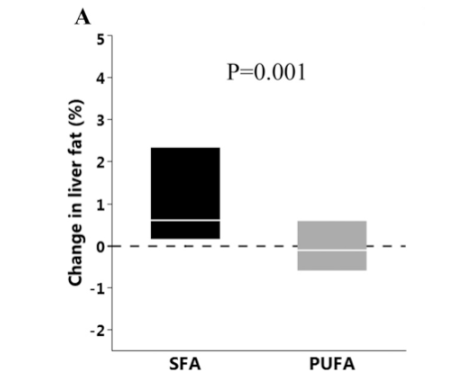
In the LIPOGAIN-2 trial, Rosqvist et al. compared PUFA-enriched to SFA-enriched overfeeding, targeting a 3% weight gain in participants over 8 weeks.
Liver fat: increased by 53% on the SFA group, compared to a 2% decrease in the PUFA group.
These divergent effects on liver fat were observed despite similar weight gain between groups.
The figure from the paper, below, illustrates the striking difference in liver fat levels between fatty acid-enriched diet groups.
The liver enzyme ALT, which is released into circulation when the liver is damaged, increased by 18% in the SFA group but remained unchanged in the PUFA group.
Why Are PUFAs Lush for the Liver?
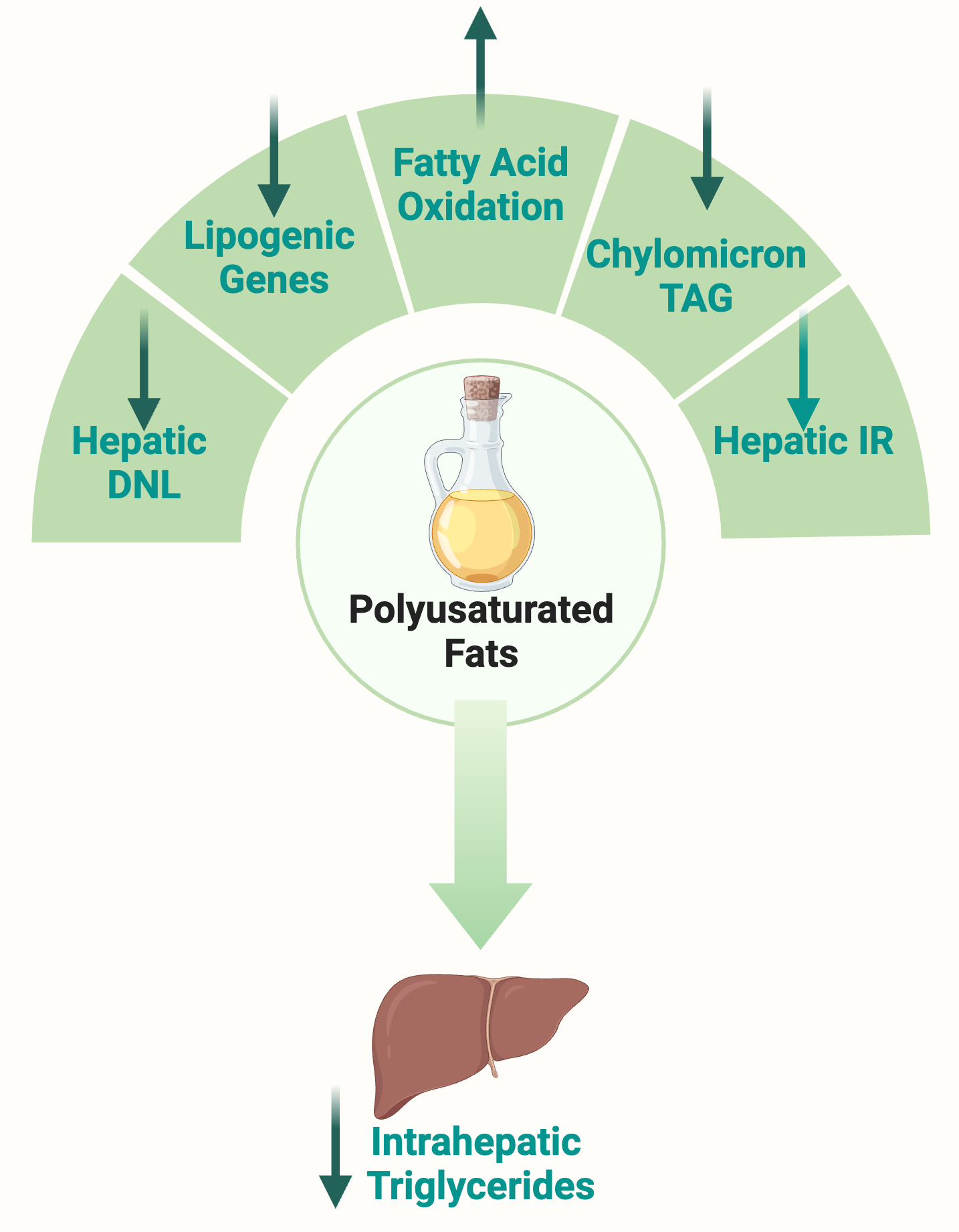
Several potential mechanisms appear to explain the benefits of PUFA on liver fat accumulation, showcasing the unique polyunsaturated fats benefits.
The first is preferential oxidation, i.e., energy utilisation, of PUFA, in which these fatty acids are referentially shuttled into oxidation, rather than storage.
The second relates to transport in chylomicrons, the large lipoproteins that shuttle triglycerides from the diet into circulation.
The PUFAs in chylomicrons are more readily broken down and released, where they are preferentially oxidised, resulting in lower post-prandial chylomicron remnants, the latter of which is a key pathway of fatty acid delivery to the liver.
The third is related to both of these preceding steps, which is that with less PUFA being delivered to the liver, there is less upregulation of new triglyceride synthesis in the liver. As a result, hepatic insulin resistance is lower.
These mechanisms are represented by the figure, below.
Saturation as the Key Hierarchy
Fundamentally, the divergent effects of fatty acids appear to boil down to one key determinant: the degree of saturation of the fatty acids.
The less saturated, as in the case of PUFA, the better for the liver, making them an essential part of any fatty liver diet.
Yours in Science,
Alan
Learn with Us.
You’ll find our most comprehensive resources in the Alinea Nutrition Education Hub.
Our weekly Deepdive takes a take a forensic look at a recent study: you’ll understand the background, the findings, and the relevance of the study in the context of the wider literature.
Our bi-monthly video Research Lectures condense complex topics into a visual presentation for you to maximise your learning experience.
And Exclusive Articles from researchers and academics in the field of nutrition science provide insights and perspectives from the people producing the research.